
Basilio Brollo’s Dictionarium sinico-latinum (Chinese-Latin dictionary) – A Critical Edition of the Manuscript Rinuccini 22 (Biblioteca Medicea Laurenziana), John Benjamins, 2026.
John Benjamins, 2026
Hardbound: ISBN 9789027237583
e-Book – Open Access: ISBN 9789027243621
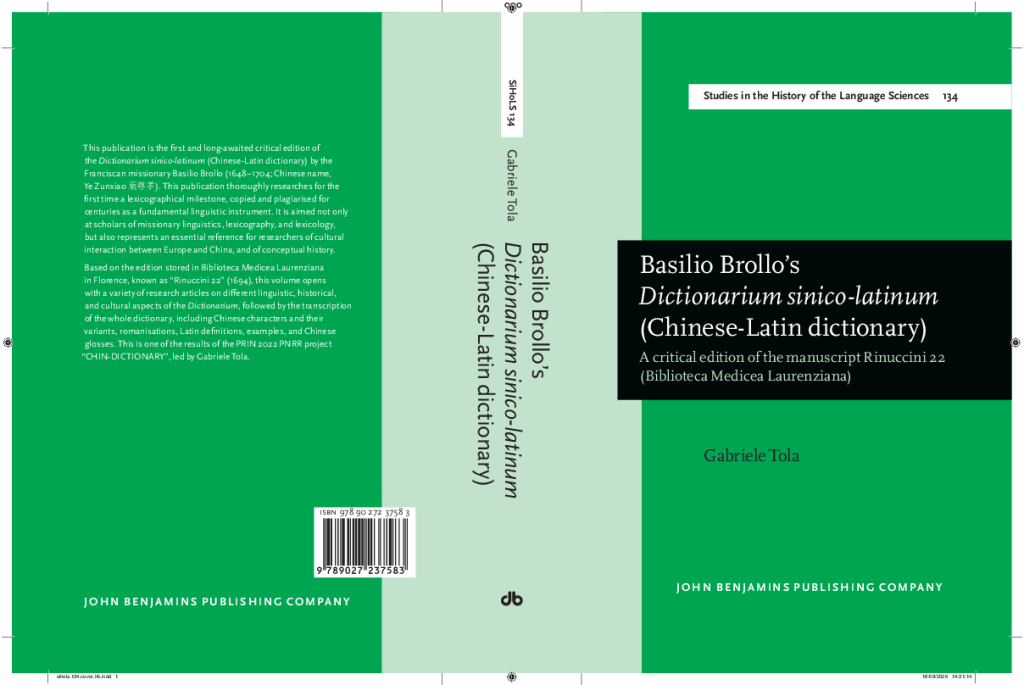
This publication is the first and long-awaited critical edition of the Dictionarium sinico-latinum (Chinese-Latin dictionary) by the Franciscan missionary Basilio Brollo (1648–1704; Chinese name, Ye Zunxiao 葉尊孝). This publication thoroughly researches for the first time a lexicographical milestone, copied and plagiarised for centuries as a fundamental linguistic instrument. It is aimed not only at scholars of missionary linguistics, lexicography, and lexicology, but also represents an essential reference for researchers of cultural interaction between Europe and China, and of conceptual history.
Based on the edition stored in Biblioteca Medicea Laurenziana in Florence, known as “Rinuccini 22” (1694), this volume opens with a variety of research articles on different linguistic, historical, and cultural aspects of the Dictionarium (see the table of contents below), followed by the transcription of the whole dictionary, including Chinese characters and their variants, romanisations, Latin definitions, examples, and Chinese glosses.
At the same time, the database https://chindictionary.lad-sapienza.it is launched.
Based on the Dictionarium sinico-latinum, this relational database has been developed to digitise and organise the data coherently. The proposed structure provides a solid foundation for indexing and querying through a search engine capable of navigating both the information explicitly present in the Dictionarium sinico-latinum and other ancient sources and the information that can be implicitly inferred. This approach ensures high flexibility and broad applicability: it allows for the generation of grammatical indexes that can be easily applied to a wide range of written sources and can be progressively enriched to include new graphic variants, pronunciations, or meanings. The database allows research on the whole text of the Dictionarium sinico-latinum with a variety of modalities.
Updates and new tools of the database are regularly released, so please check the website regularly.
The volume and database are among the results of research conducted within the PRIN (Research Projects of Significant National Interest) 2022 PNRR project “CHINDICTIONARY– Brollo’s Dictionarium sinico-latinum: linguistic innovations, textual connections, and trans-cultural translation”, funded by the European Union–NextGenerationEU, as part of the implementation of the National Recovery and Resilience Plan (Piano Nazionale di Ripresa e Resilienza, PNRR), with funding of the Project PRIN 2022 PNRR (M4C2- Investment 1.1) — Project code P2022XBX35; CUP MASTER B53D2302933 0001; CUP B53D23029330001). The project is led by the principal investigator Gabriele Tola (Sapienza University of Rome, with local unit members Federico Masini and Paolo De Troia), in collaboration with two local investigators, Victoria Almonte (University of Tuscia) and Emanuele Raini (University of Naples “L’Orientale”); the research team is composed by Erica Cecchetti, Silvana Maiello, and Erasmo Di Fonso (Sapienza University of Rome), Ya Chen (University of Tuscia), and Mattia Marconi (University of Naples “L’Orientale”).
Table of Contents
- Introduction – Gabriele Tola | pp. vii–xiv
- Preface – Federico Masini | pp. xv–xviii
- Preface – Paolo De Troia | pp. xix–xxii
- Acknowledgments | pp. xxiii–xxiv
- Technical and linguistic notes for the reader on the textualisation of the manuscript Rinuccini 22 – Gabriele Tola | pp. xxv–xxviii
- Chapter 1. In search of clues for dating Rinuccini 22 and Borg. Cin. 475: A comparison of the historical and biographical notes found in the two manuscripts – Mattia Marconi | pp. 1–15
- Chapter 2. Brollo and romanisation: Theory, practice, and cross-cultural context – Emanuele Raini | pp. 16–33
- Chapter 3. Tracing the metalinguistic markedness of Basilio Brollo’s Dictionarium sinico-latinum: A tool for contemporary readers – Silvana Maiello | pp. 34–53
- Chapter 4. Brollo’s Dictionarium sinico-latinum and Christian Catholic terms – Mattia Marconi | pp. 54–75
- Chapter 5. Sino-Franciscan landscapes: Toponyms and selected geographical terms in Brollo’s Dictionarium sinico-latinum — A case study – Erica Cecchetti | pp. 76–94
- Chapter 6. Female figures in the Dictionarium sinico‑latinum – Ya Chen | pp. 95–106
- Chapter 7. Linguistic aspects of rice terminology: A preliminary study on rice cultivation in Brollo’s Dictionarium sinico-latinum – Victoria Almonte and Ya Chen | pp. 107–125
- Chapter 8. Brollo’s Dictionarium sinico-latinum and later lexicographical production: The connection with Dominicans and late Qing dictionaries – Gabriele Tola | pp. 126–140
- Chapter 9. Brollo’s Dictionarium sinico-latinum database: Developing a flexible information system for the digital analysis of ancient bilingual Chinese dictionaries – Erasmo Di Fonso | pp. 141–158
- Note on how to use and read the dictionary – Emanuele Raini | pp. 159–162
- Operis ratio, et usus – Silvana Maiello, Emanuele Raini and Gabriele Tola | pp. 163–168
- The structure and utility of this work – Silvana Maiello, Emanuele Raini and Gabriele Tola | pp. 169–175
- Index | pp. 176–181
- Dictionarium sinico-latinum | pp. 182–985
- 相反之字 | pp. 986–1010
- 相連俗語 | pp. 1011–1017
- Particulae numerales | pp. 1018–1022
- General index | pp. 1023–1029
Download this announcement’s official PDF: